Skip to content

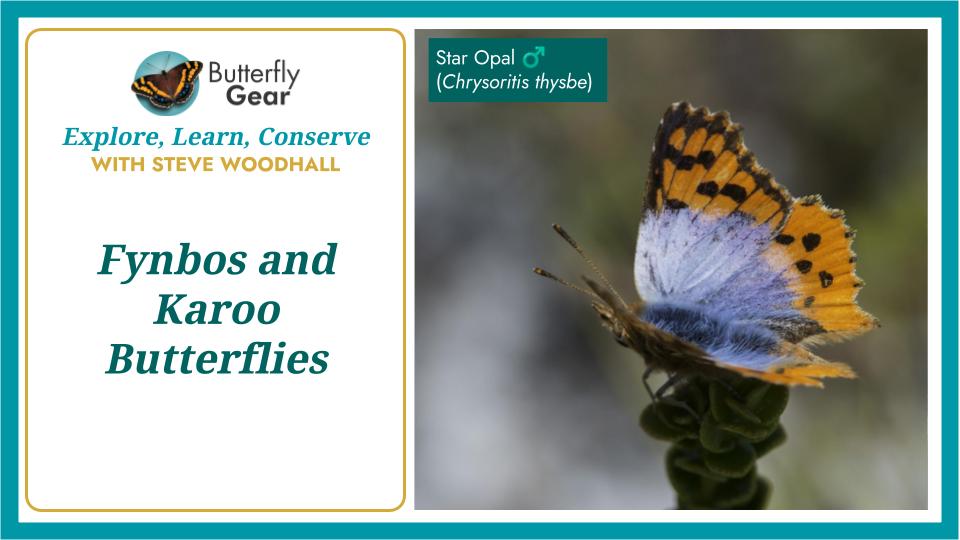
Fynbos and Karoo butterflies
Categories: Biomes
Wishlist Share

What Will You Learn?

  • What is special about the Fynbos, Nama Karoo, and Succulent Karoo Biomes in South Africa
  • What links these biomes, and why they can be considered as a single system under the label 'Capensis' from a butterfly perspective
  • How butterflies adapt to 'Capensis' conditions
  • What are the various vegetation types within these Biomes and how their differences are reflected in their butterfly fauna
  • Examples of links between Fynbos and Karoo butterflies and their relatives in the Grassland, Savanna, and Albany Thicket biomes
  • This is too huge a subject to be covered adequately on a short course like this, but it will help you to gain the understanding needed to to study it further. Then come on one of my on-site courses and ask me questions about butterflies in real life!

Course Content

‘Capensis’ biomes – introduction
South Africa’s Fynbos biome and the two Karoo biomes—Nama Karoo and Succulent Karoo—have vegetation that differs from the subtropical, summer-rainfall regions farther north. These three biomes are closely linked and reflect how vegetation has evolved over millions of years in response to changing abiotic conditions. The butterflies found there are also closely related, so we have grouped them together under the name ‘Capensis’, meaning ‘from the Cape’. The term refers to the former Cape Province of South Africa and is often used in the names of organisms native to these biomes.

  • Capensis Biodiversity
    15:40
  • Capensis butterfly examples
    15:40
  • The Nama- and Succulent Karoo and Fynbos Biomes in general and how their characteristics affect South African butterflies

‘Capensis’ butterflies – specialist species
South Africa has three biomes that are unique to this subcontinent. Nama karoo, Succulent karoo, and Fynbos. There are several species of butterfly that are confined to each of these biomes and may appear to be biome specialists. But at genus level almost none are confined to a particular biome. The butterfly genera we find in them mostly slowly evolved elsewhere and their species have been modified by changing selection pressures inside the biomes over recent geological time.

‘Capensis’ butterflies – parallels with neighbouring biomes
Many karoo (Succulent or Nama) butterflies are closely allied to savanna species and probably evolved from them. As well as species pairs, some butterfly species have multiple subspecies found across different biomes. Some butterflies exist as multiple closely related similar species found across different biomes including Fynbos and Succulent/Nama karoo.

Habits of karoo and fynbos butterflies, and how they interact with their habitats.
The same broad types of butterflies tend to be found across Fynbos and Succulent/Nama karoo. At genus level they had mostly evolved before the formation of these biomes. The specialist butterflies found in them most likely evolved from subtropical species that existed in Africa before the subcontinent was uplifted and became arid. Because they are mobile and tend to use certain landscape features as meeting points it helps to know what to look for in these landscapes.

Fynbos and Karoo butterflies – more examples of the ecological niches they’ve adapted to
Fynbos and the two Karoo biomes are home to some specialized butterflies that originally evolved in the grasslands and savanna but have adapted and changed to take advantage of ecological niches in what we’re calling the ‘Capensis’ biomes. We look more deeply into some examples.

Want to receive push notifications for all major on-site activities?